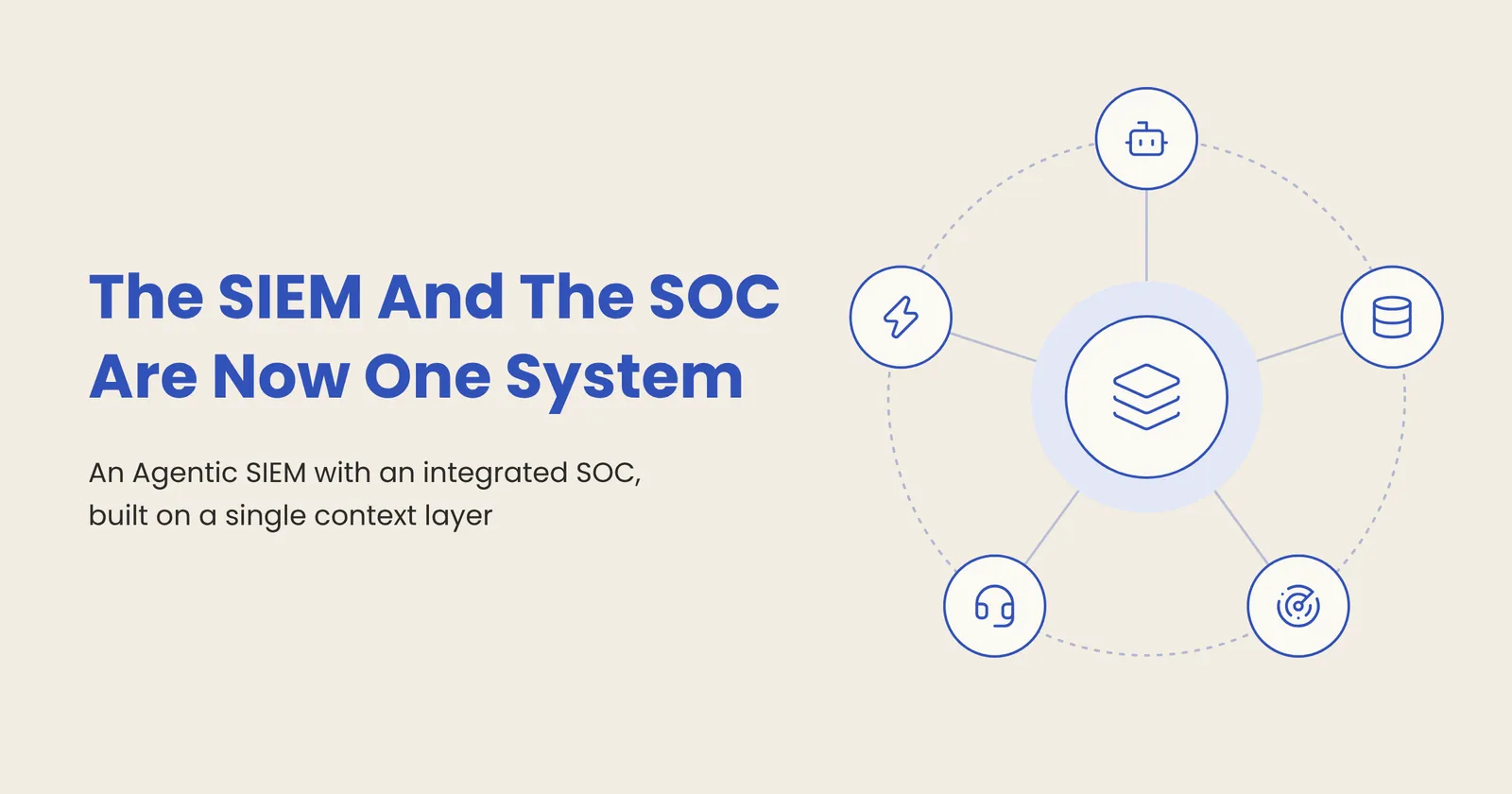
An Agentic SIEM with an integrated SOC, built on a single context layer
TL;DR#
Security operations has been playing a game of whispers: one vendor hears the data, another decides what it means, a third acts on what it was told. In the AI era, that line breaks.
- Splitting data, detection and response across vendors loses context at every handoff, and attackers work in those gaps.
- SIEM and SOC have to run as one AI-native system. Agents need one vocabulary and one memory to reason, and the enterprise's own agents must be watched as entities.
- AI SOCs and managed services running on legacy pipelines inherit those pipelines' blind spots, however good the team behind them.
- Trench is an Agentic SIEM with an integrated SOC: TASC, Signal Memory, Intent Graph and Headless SecOps on one context layer. A unified SecOps platform for modern security teams and the providers who serve them.
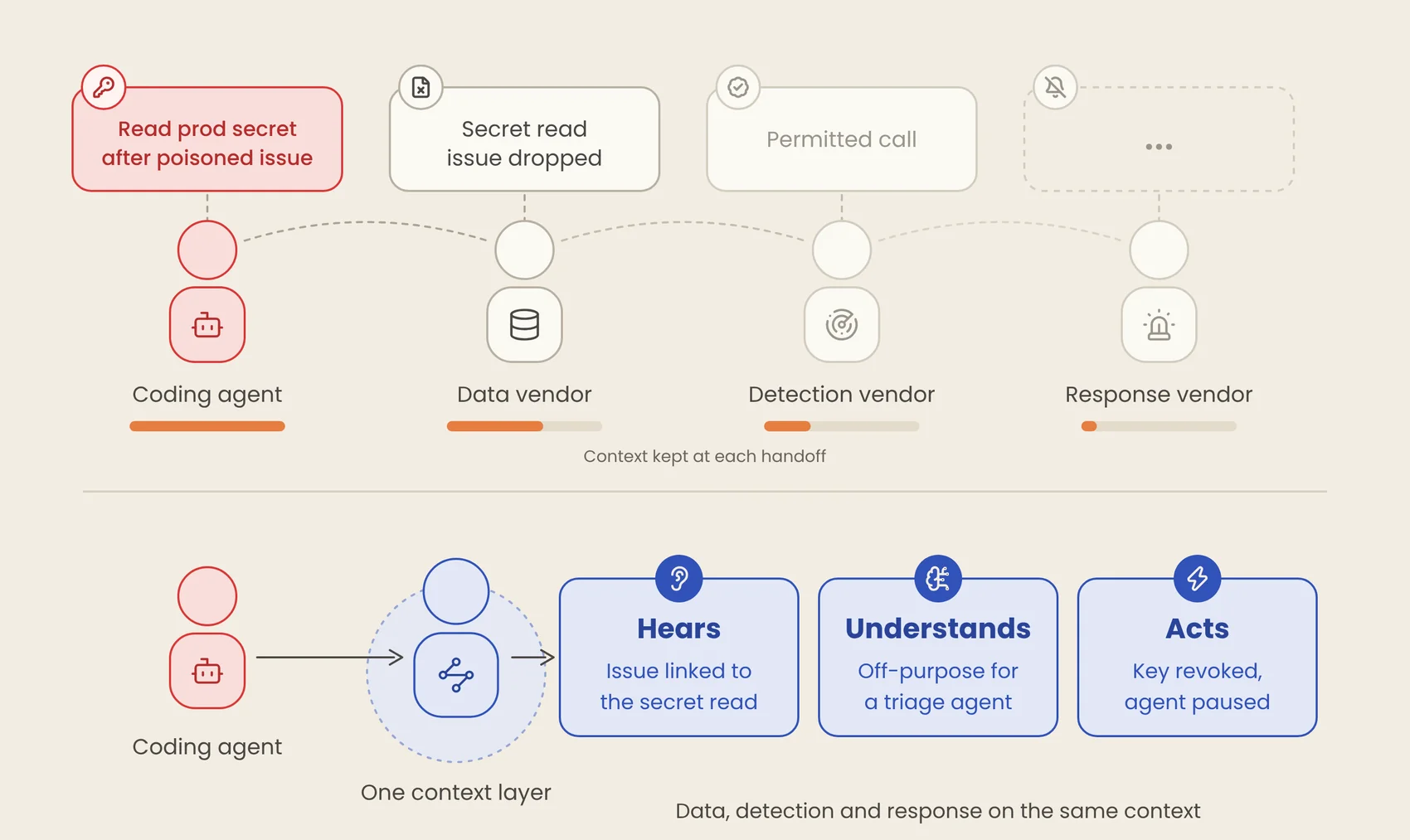
Everyone has played the game where a message is whispered down a line and the last person says it out loud. It rarely survives. Now give each person a different job. The first only hears the words. The second decides what they mean. The third acts on what it was told. Each one does its part well, and the meaning that started the message is still gone by the end.
Most enterprises run security operations this way. One vendor collects and moves the data. Another detects and correlates. A third investigates and responds. Every handoff between them is another whisper down the line, and each one loses context.
AI transformation changes what you are defending#
Enterprises are moving from systems of record to systems of action. Workflows that people ran are being handed to agents. Each agent is a new machine identity with access, autonomy and no history.
Take a healthcare company that deploys a prior-authorization agent. It reads patient records and submits requests to payer portals around the clock. Thousands of record reads at three in the morning would be an anomaly for a person. For this agent it is a normal Tuesday. When the agent is hijacked, its malicious activity looks like more of the same, and behavior analytics tuned for people have nothing to compare it to.
The core question of an investigation changes with this shift. It used to be who did this. Now it is what was this meant to do. A hijacked agent does not need stolen credentials, because it already has every permission it was given. Defending that shift with a stack built for human workflows means answering a new question with old context.
SIEM is a discipline, not a product#
The SIEM was never really a product. It is a discipline: collect what happened, give it meaning, remember it, correlate it and decide what to do. Any tool doing those jobs is practicing SIEM, whatever the label on the box says. That is why every so-called SIEM killer ends up becoming one. XDR, security data lakes, SOAR and AI SOC tools each arrive as the replacement, and each ends up practicing the same discipline, usually only in part.
Take a fintech security team that retires its SIEM to cut ingestion cost. Endpoint telemetry goes to an XDR, cloud logs to a data lake, triage to an AI SOC. Before long, answering "which identity touched the payments bucket last night" means three consoles, two query languages and a spreadsheet to join them. The team has rebuilt its SIEM by hand, and the team itself is now the correlation engine.
One popular response is to break the SIEM into swappable parts. That helps storage economics. It hurts reasoning, because every seam is a place where meaning leaks. The discipline needs one memory and one vocabulary, which is why the foundation matters more than the agent placed on top of it (see The Agent Is Not the Product. The Foundation Is.). Even the largest platform vendors now ship SIEM and response as one experience, though most unify at the console while the context underneath still comes from separate pipelines.
So why agentic? Because the discipline is changing hands. For two decades people practiced it, with the SIEM as their notebook. In Trench, agents practice it: they correlate, investigate and propose the decision, while people approve and steer. The word points the other way too. The enterprise is filling with agents, and a SIEM that cannot see them as entities, baseline them and contain them is not defending the business it runs in. Trench is agentic in both directions: run by agents, and built to defend them.
Where the context loop breaks#
Take a SaaS company whose engineering team runs a coding agent with access to the repository, the CI pipeline and a read role in production cloud. An attacker opens a public issue with hidden instructions. The agent, triaging issues, follows them: it reads a production secret and adds a new deploy key to the repository.
Now follow it through a three-vendor stack. The pipeline vendor routed repository audit logs to cold storage to control ingestion cost, so the issue that triggered the action never reaches detection. The SIEM sees a permitted secret read by a known role, and no rule fires. The AI SOC or managed provider never gets an alert, so it never starts. No single layer did anything wrong, and the secret is gone.
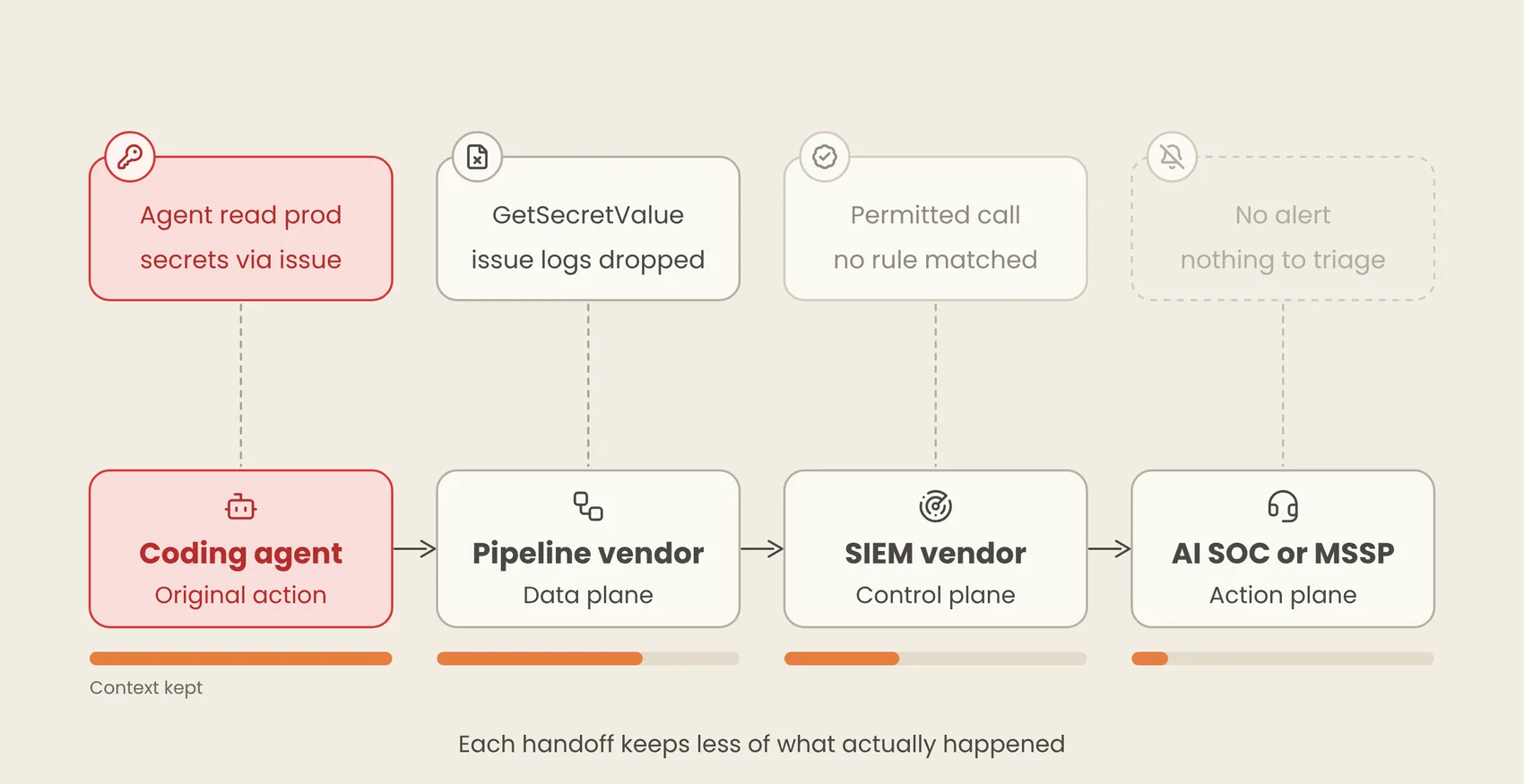
Catching this takes a system that holds the whole workflow at once: what the agent is for, what it normally touches, and what triggered this action. The agent exists to triage issues and open pull requests. Reading production secrets is not part of that purpose, and only something that sees the full chain can tell. We traced this failure across the data, control and action planes in Cyber Defense 2.0 Part 2.
Why the SOC belongs inside the SIEM#
A SOC is a function, not a room. It is the work of triage, investigation and response. In most stacks that work starts downstream of the SIEM, in another product, after the alert. It works from whatever detection chose to pass on, queries data it does not own, and acts through a third tool.
That split made sense when detection was a rule and investigation was a person. In the AI era they are the same act. An agent asking whether a secret read fits the coding agent's purpose is detecting and investigating at once. Split that reasoning across products and it happens twice, with less context the second time. In the coding agent case, a separate SOC would receive "permitted secret read by known role" and have to rebuild the issue, the agent's purpose and its history from scratch, if it could reach them at all.
So integration is not a packaging choice. It is what lets the reasoning that finds a threat be the same reasoning that resolves it. In Trench, the agent that spots the off-purpose action is the one that investigates it and proposes the response, composing the investigation as it goes rather than following a fixed script (see Trench Agentic SecOps: Playbooks vs. Skills).
‘Integrated’ has to mean AI native#
Putting a SIEM and a SOC in one console is not the same as integrating them. If the data model underneath was built for human search, the agents on top inherit its ambiguity, and reasoning does not tolerate ambiguity the way search does.
Take one service account. In identity logs it appears as an email-style login. In cloud audit logs it appears as a role ARN. An analyst knows these are the same entity. An agent sees two strangers, and the lateral movement between them disappears from its investigation. It then reasons confidently from a wrong premise.
So the platform has to be AI native, designed for machine reasoning from the first byte of the data model up. AI added to a legacy SIEM shows up as a copilot sitting on the same alert queue. In an AI-native platform, the agent reasons over a graph of behavior, not a stream of logs. That difference decides whether the agent investigates or just summarizes.
AI SOCs add another voice to the line#
The newest answer to SOC overload is an AI SOC: an agent that sits downstream of the existing SIEM and triages whatever it is handed. It makes the last person in the line faster. It does nothing for what was lost before the message arrived, and it adds one more handoff to a model that was already fragmented.
It also assumes the line is already in good order. AI maturity moves through five stages: awareness, experimentation, a first initiative in production, workflows reshaped around AI, and AI as the product itself. Most organizations sit in the first two. Most AI SOC tooling assumes the last two.
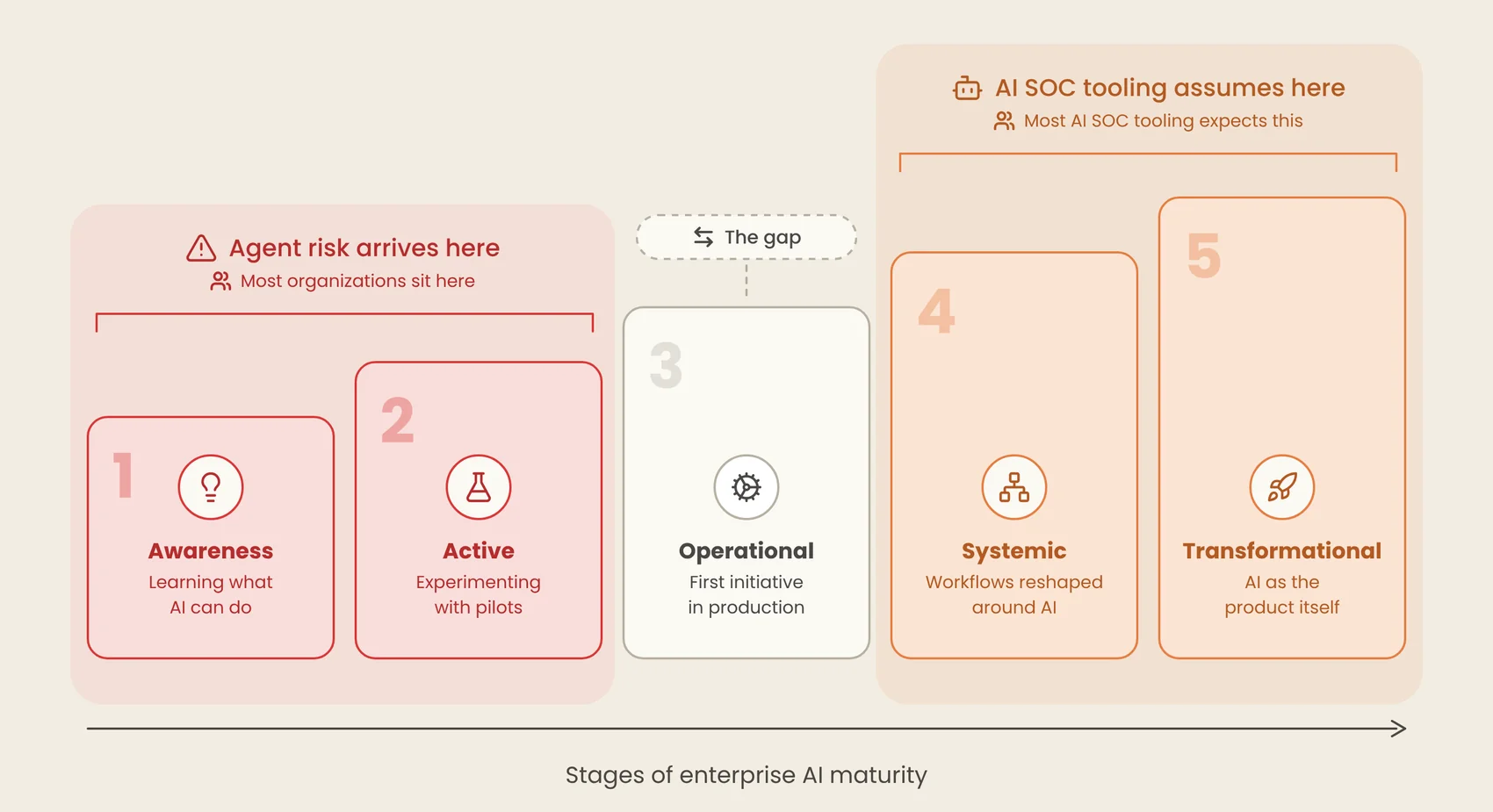
Take a fintech whose product team wires agents to the payments platform before security knows they exist. The AI SOC it evaluates asks for normalized data, tuned detections, documented workflows and agreed response policies before onboarding. It expects an enterprise that has finished its transformation.
That gap lands on the customer. SANS reports that the most common SOC has two to 10 people. For a team that size, fixing pipelines and mapping data across three vendors' data models turns the promised autonomy into an integration project. Meanwhile the exposure arrives early in the maturity curve, while the defenses assume the end of it.
Managed services inherit the same gap#
Many security teams bring in a managed provider, and the good ones add real expertise and round-the-clock coverage. But a provider at the end of a fragmented stack sees only what the customer's pipeline forwards. However skilled the analysts, they are handed the message at the end of the line.
Picture the coding agent again, this time with a sharper rule in place. At three in the morning a ticket arrives: unusual secret access by the CI agent, please confirm whether this is expected. The provider has done its job with what it could see. The context it needed to finish the investigation never reached it, so the question goes back to the customer.
Security leaders feel this. In a KPMG survey, 66% of executives expressed doubts about their choice of MSSP, particularly for managed detection and response. A MITRE Engenuity study found that while 68% use MSSP or MDR services to fill security gaps, 47% are not confident in the technology or the people. Neither number is a verdict on providers. It is what happens when expert teams are handed partial context.
The providers that pull ahead will be the ones running an integrated SOC on top of an Agentic SIEM, working from one unified SecOps platform instead of forwarded feeds. They share the customer's context and hand back outcomes instead of questions. Trench is built to be that foundation for providers as much as for in-house teams.
What changes when agents sit on the right foundation#
AI SOC tools and managed services inherit whatever the stack beneath them can see, and legacy stacks see less than their owners think. CardinalOps' analysis of production SIEMs found that 13% of detection rules on average will never trigger because of misconfigured data sources and missing log fields, and that enterprise SIEMs cover just 21% of MITRE ATT&CK techniques. Anyone triaging those alerts, human or agent, is working from a partial record.
| AI SOC on a legacy stack | MDR on a legacy stack | Agents on an AI-native SIEM (Trench) | |
|---|---|---|---|
| Context | Reasons over fields mapped by other vendors; broken mappings silently remove evidence | Sees what the customer's pipeline forwards | TASC gives one meaning at ingestion; Signal Memory baselines every human and agent |
| Detection | Triages alerts from rules after they fire | Same rules, worked through an analyst queue | Intent Graph checks each action against its purpose; Zero Latency Threat Detection |
| Signal-to-noise ratio | Inherits the noise of the rules beneath it and summarizes it faster | Filters what it receives; ambiguous cases go back to the customer | The model reads entities and relationships, not raw logs, so noise is cut before reasoning starts |
| Decision quality | Confident verdicts on partial evidence that analysts re-check | Expert judgment limited by missing business context | Decisions grounded in purpose and history, with every conclusion traceable to its source signals |
Signal-to-noise is where the architecture shows up most clearly. In Trench Labs research, reasoning over entities and relationships instead of raw logs cut the volume reaching the model by about 96.5% while keeping over 99% of attack-related events. Less noise in means fewer false positives out, and a cost curve that flattens as customers grow. Precision follows from the same design. An agent that knows what an entity is for, and what it has done before, makes decisions a person can approve in one step instead of re-investigating.
One context layer, one system of defense#
Trench merges the data, control and action planes into one agentic platform. That is the basis for calling it an Agentic SIEM with an Integrated SOC. The industry would call it a unified SecOps platform; the difference is where the unification happens. It happens at the context layer, not the console, and that is why it can meet an enterprise wherever it sits on the maturity curve.
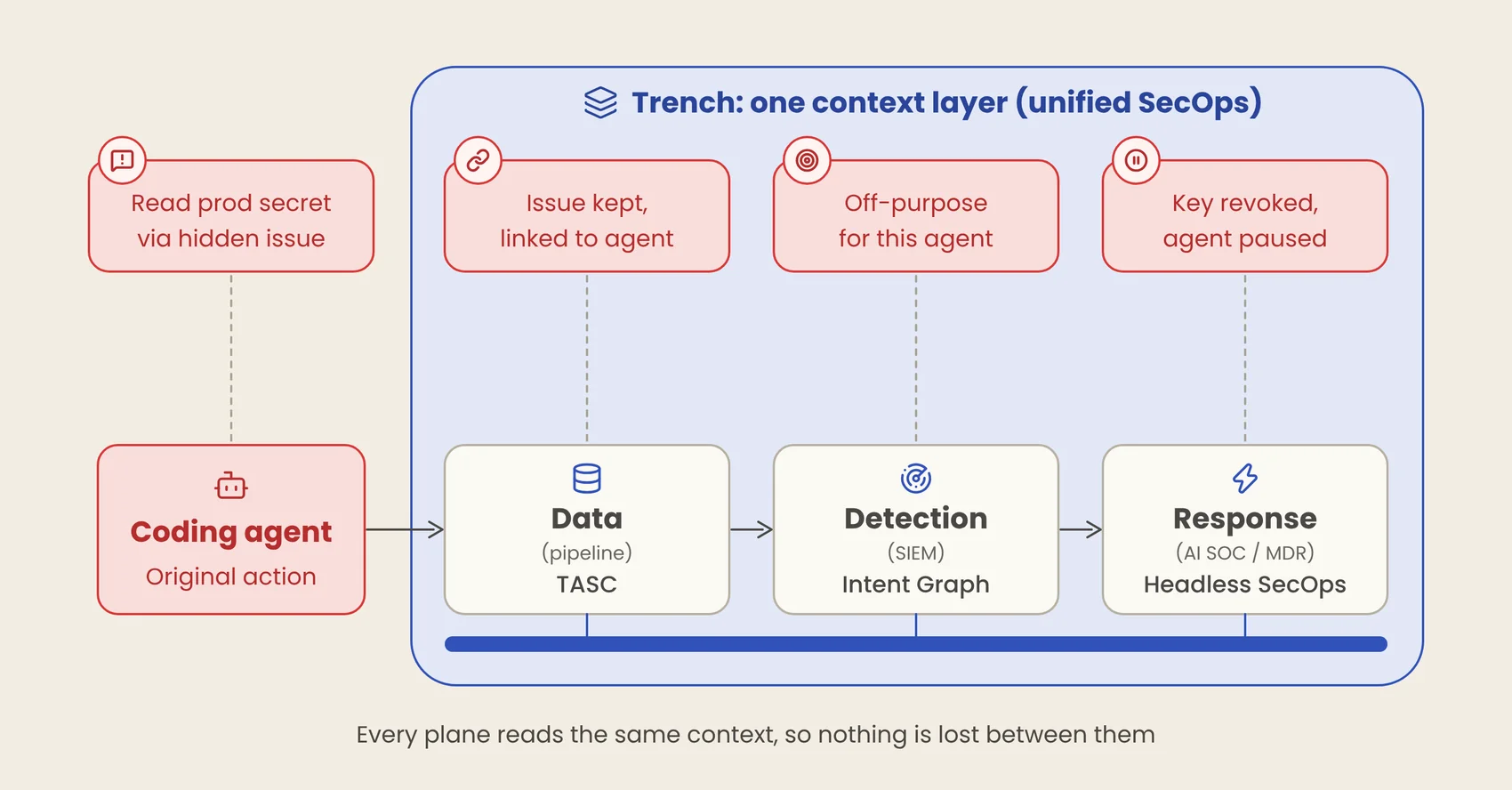
Run the coding agent through Trench. On the data plane, TASC gives the issue, the secret read and the deploy key one shared security meaning, so the agent's identity resolves to a single entity across every source. Signal Memory already holds that agent's baseline, built from the moment it appeared. Because Trench brings its own data plane, the triggering issue is never routed away to save cost.
On the control plane, the Intent Graph knows the agent exists to triage issues and open pull requests. A production secret read followed by a new deploy key falls outside that purpose, even though each step was permitted. This is Intent Graph-based detection, and it runs on the same layer that holds the data, so nothing waits on a handoff between products. We call this Zero Latency Threat Detection.
On the action plane, Headless SecOps brings the finding into the tools the team already uses, with one approval to revoke the key and pause the agent (see Actionable SecOps in the Real World). Autonomy grows as the organization matures: a person approves each action early on, and the system takes on more as trust builds. Actionable SecOps means getting from signal to outcome without a person stitching the steps together.
The SIEM and the SOC stop being separate systems you buy and integrate. Detection and response become outputs of the same layer, and that layer is the new system of defense for an AI-driven threat landscape.
Bottom line#
Go back to the line of whisperers. Training them to whisper more clearly will not fix it, and neither will adding someone at the end of the line. What fixes it is one listener who hears, understands and acts on the message without passing it on. In the AI era, the SIEM and the SOC are no longer two purchases. They are one system of defense, and as enterprises hand more of their work to agents, that unbroken context is where it has to live.
Trench fixes your blind spots in minutes.
See it liveDiscussion (0)
No comments yet. Be the first to start the discussion!