No alerts. No dashboards. Just decisions that matter.
Decades of Innovation. One Unsolved Problem.#
Before building Trench, I have spent a decade in cybersecurity product management - sitting across from security engineers, senior analysts, and SOC managers. Not in polished sales calls. In the conversations where people tell you what is actually going on.
Alert fatigue comes up every time. Not as a complaint. As a resignation. Across SIEM generations, across EDR vendors, across XDR platforms, across the AI wave - the problem did not move. Every technology cycle promised relief. None delivered it.
But here is what I came to understand: alert fatigue is the symptom. Cognitive overload is the disease. The constant context-switching between six consoles. The manual stitching of signals that should already be correlated. The high-stakes decisions made with incomplete information, under time pressure, at 11 PM. The queue that resets every morning like nothing was accomplished the night before. It is not the volume of alerts that breaks people - it is the architecture that makes every single alert a fresh cognitive task with no system support behind it.
Every vendor acknowledged the problem. None solved it. They moved it one layer up the stack.
Then came the AI wave - and it made things worse. What the industry delivered was AI-assisted triage: more signals processed, more dashboards surfaced, more enriched context to read. I spoke with a security engineer at a FinTech company who had deployed an AI layer specifically to reduce cognitive load. Their words:
“It helped us understand what we were ignoring faster. We're still ignoring the same amount.”
AI gave security teams better visibility. It made detection faster. But it stopped exactly where the hard part begins - action. The missing piece in the existing equation was never more data or faster alerts. It was actionability. The ability to go from signal to outcome without a human manually bridging every step in between.
That is not a tooling gap. That is a systems design flaw.
Which is exactly why we built Trench - with actionability as the founding principle, not an afterthought. The approach: Headless SecOps.
The missing piece was always actionability.
Explore TrenchDesigned for Outcomes, Not Interfaces#
The security industry has spent two decades optimising for two things: visibility - knowing what is happening across your environment - and velocity - detecting threats faster. Both matter. Neither is sufficient.
Visibility without actionability is just a better view of a problem you still cannot solve fast enough.
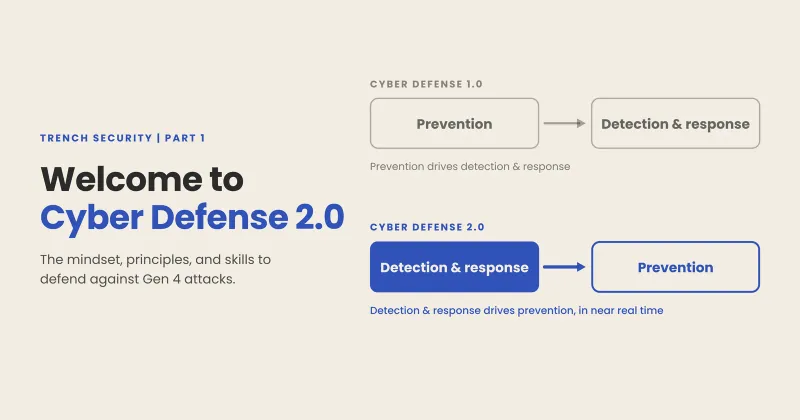
The term "headless" comes from software architecture. A headless system does its work - processing, logic, intelligence - without rendering a permanent interface for a human to monitor. The output is an outcome, not a dashboard. Headless SecOps applies the same principle to security operations - with actionability as the design principle and an agentic system as the engine that makes it real.
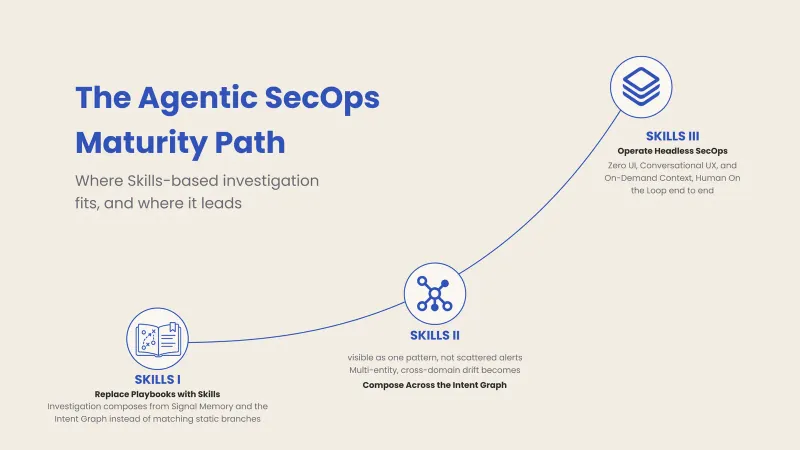
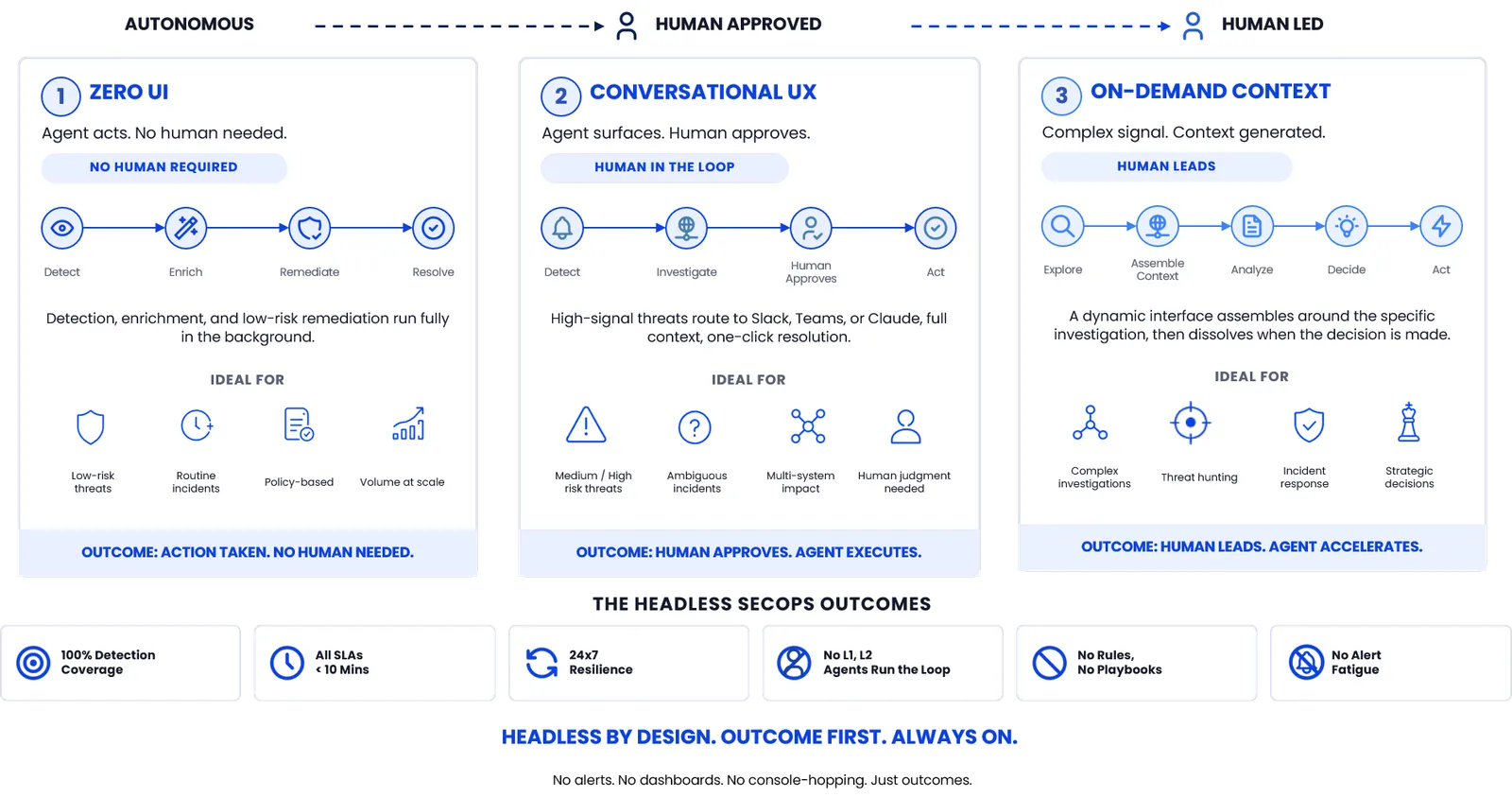
It operates across three distinct modes - each one a different expression of actionability:
The Three Modes of Headless SecOps#
- Zero UI : The agent acts. No human needed, no console opened. Detection fires, context is assembled, low-risk remediations execute automatically. Actionability at machine speed, invisibly.
- Conversational UX : For decisions that require human judgment, the agent surfaces into where your team already works : Slack, Teams, or Claude. Full context, one-click approval. Actionability inside the thread, without leaving it.
- On-Demand Context : For complex investigations, a dynamic interface is generated for that specific decision moment. Context assembled on demand, investigation closed, interface dissolved. Actionability on the analyst's terms, not the dashboard's.
In the alert-centric model, the human is the integration layer - the only bridge between visibility and action. In Headless SecOps, the agentic system closes that gap. The human enters only at the mode that matches the decision's complexity.
The judgment stays with your team. Everything between signal and outcome does not.
Visibility and velocity were always prerequisites - we covered why the foundation matters. Actionability is what the right foundation makes possible.
Your Collaboration Tool Is Now Your SOC#
The agentic layer is what makes actionability real rather than theoretical. For every event that enters the system, the agent determines the right mode - autonomously, in real time, without human classification. Low-risk and pattern-matched: action taken silently.
High-confidence threat requiring a judgment call: surfaced in your collaboration tool with context pre-assembled and remediation pre-staged. Complex unknown behaviour: investigation scaffolded on demand, findings surfaced, actions proposed.
In each case, the loop closes. Action happens. The outcome is delivered - not a ticket, not an enriched alert, not a recommendation sitting in a queue.
Below are three scenarios - each showing a different mode in action. A threat verified and closed before morning. A false positive suppressed before anyone was paged. A hunt that surfaced what passive monitoring missed entirely.
Visualizer: Incident Lifecycle Comparison
Legacy MTTR (4.2 Hours) vs Trench Autonomous Decisioning (Under 5 Seconds).
One Agentic System. Three Modes. Always Running.#
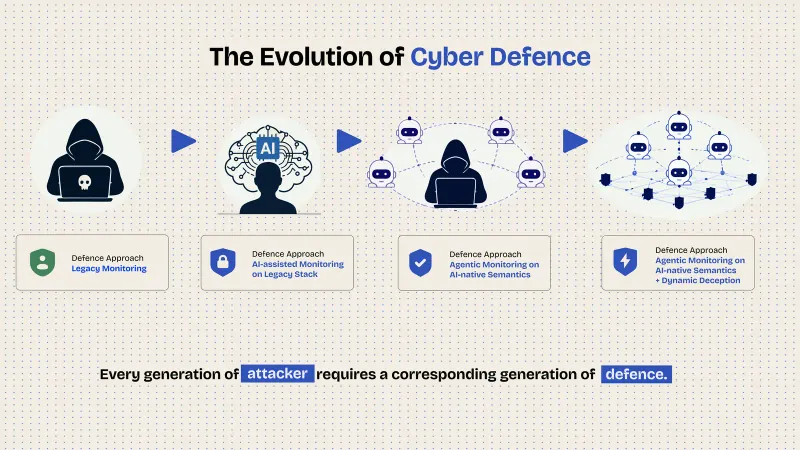
Frontier AI is making blindspots the default, not the exception. Attacks are faster, more adaptive, and increasingly automated. The old model: a SIEM with a SOC layer on top was built to improve visibility. It was never designed to deliver actionability. It is breaking under the weight of exactly the threat environment it was supposed to defend against.
The industry gave us visibility. Then it gave us velocity. What it never gave us was actionability the ability for the system to close the loop, end-to-end, without a human manually bridging every step.
Headless SecOps is the architecture that finally delivers it. From cognitive overload to cognitive harmony not by adding another layer of intelligence for your team to process, but by building an agentic system that turns every signal into an outcome. The result is a security team that makes better decisions, faster, with the clarity to protect the organisation against threats that move at machine speed.
This is the foundational application of agentic AI in security operations. Not a copilot. Not a dashboard upgrade. An agentic system where detection, verification, and remediation run end-to-end closing every loop, at every layer, always.
This is built for the next generation of security champions - the ones who are not waiting for the old model to catch up, who see agentic AI not as a threat to manage but as the advantage to run with.
“The best interface is no interface.” - Steve Jobs
In security operations, the best interface is one your team never has to open - because the work is already done. This is your Trench.
Trench is the Agentic Operating System for Actionable SecOps.
Built for lean security teams who need outcomes, not dashboards.
See Headless SecOps in action